Confusing traffic signal

The two intersections near my office have traffic lights that are unlike any others I’ve seen, and I fear that they are confusing to drivers and therefore dangerous.

On the north and south sides of the intersection there are three lanes: a left turn lane, a through lane, and a right turn lane. On the east and west sides, there are four lanes (two through lanes). All four sides of the intersection have the normal red/yellow/green through lights and a left turn light.

A traditional traffic light is green, turns yellow for a short period, and then turns red. They have been this way for decades–certainly for the 40+ years I’ve been aware of the way that traffic lights work. Left turn lights work much the same way. The left turn arrow might work on a different schedule than the through lights, but it traditionally follows the green to yellow to red pattern. Or, it might have only green and off, meaning that you have to yield to oncoming traffic when the light is off, but the oncoming traffic has a red light when the left turn light is green.

The left turn lights at this intersection are different. And confusing. They blink yellow to mean, “You may turn after yielding to oncoming traffic.” After the blinking yellow period, they turn green. So drivers have to know that solid yellow means “red is soon to come,” but blinking yellow means, “green is soon to come.”

It doesn’t help, of course, that years of experience have taught drivers that in practice a yellow left turn signal means, “Hurry up through the intersection before the light turns red.”

Every day I see drivers not fully understanding what that blinking yellow means. Some, when they see the blinking yellow, dash through the intersection heedless of oncoming traffic. I can only conclude that they don’t understand that the rules have changed and a light might start blinking yellow. Other drivers see the blinking yellow and hesitate when it’s clear that there is no oncoming traffic and they’re fully within their rights to proceed.

I realize that blinking yellow means “proceed with caution.” But traditionally that’s done with all of the lanes at an intersection (going the same way, of course). But drivers aren’t accustomed to seeing blinking yellow on one light, and solid red or green on the other lights. And they’re certainly not prepared for a blinking yellow light to suddenly go green.

I’ll grant that I’ve only seen two crashes (after the fact–I wasn’t present for the actual impact) at these intersections in the three months I’ve been here. But I’ve seen too many close calls to believe that this unorthodox use of the signal lights is a good idea. I can only hope that those in charge of the traffic lights will see this dangerous situation for what it is and reprogram the lights back to something more reasonable.
Metabolic efficiency

I’ve long wondered just how efficient the human body is at extracting energy from food. We’re told, for example, that every gram of fat contains nine calories, and that protein and carbohydrate each contain four calories per gram. The implication is that if we consume some amount of fat, protein, and carbohydrates, our bodies will extract all of that energy.

But is that true? Do our bodies really extract and store all of those calories?

We already know that individuals differ. Some exist on a diet of primarily carbohydrates, and gain weight quickly if they eat fat and protein. Others seem to turn every gram of carbohydrate into two grams of fat on their hips. (Yes, that’s an exaggeration.) Is is possible that some people metabolize fat more efficiently, and that others metabolize carbohydrate more efficiently?

I think it’s likely, but I’ve been unable to come up with solid numbers. What is the average efficiency? Has it been measured? If so, how widely does it vary among individuals?

I’d sure be interested if you could point me to solid research in this area.

Ozzy the tortoise

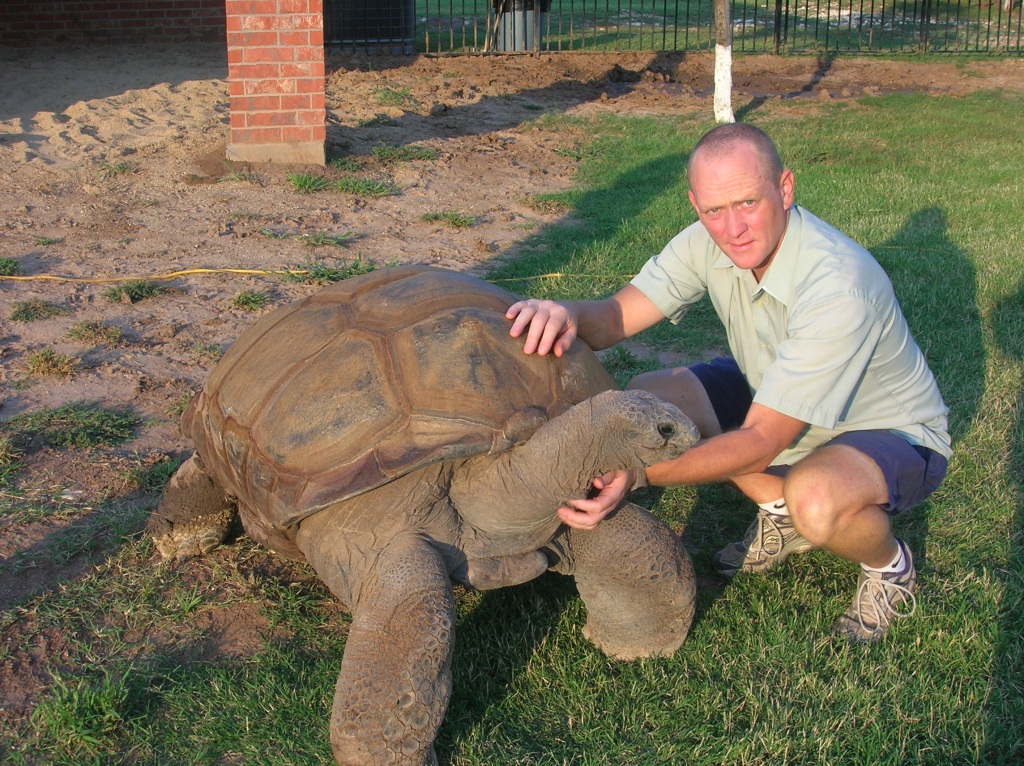
Ozzy is an Aldabra giant tortoise. He lives at my friend Jack’s place near Waco, TX.

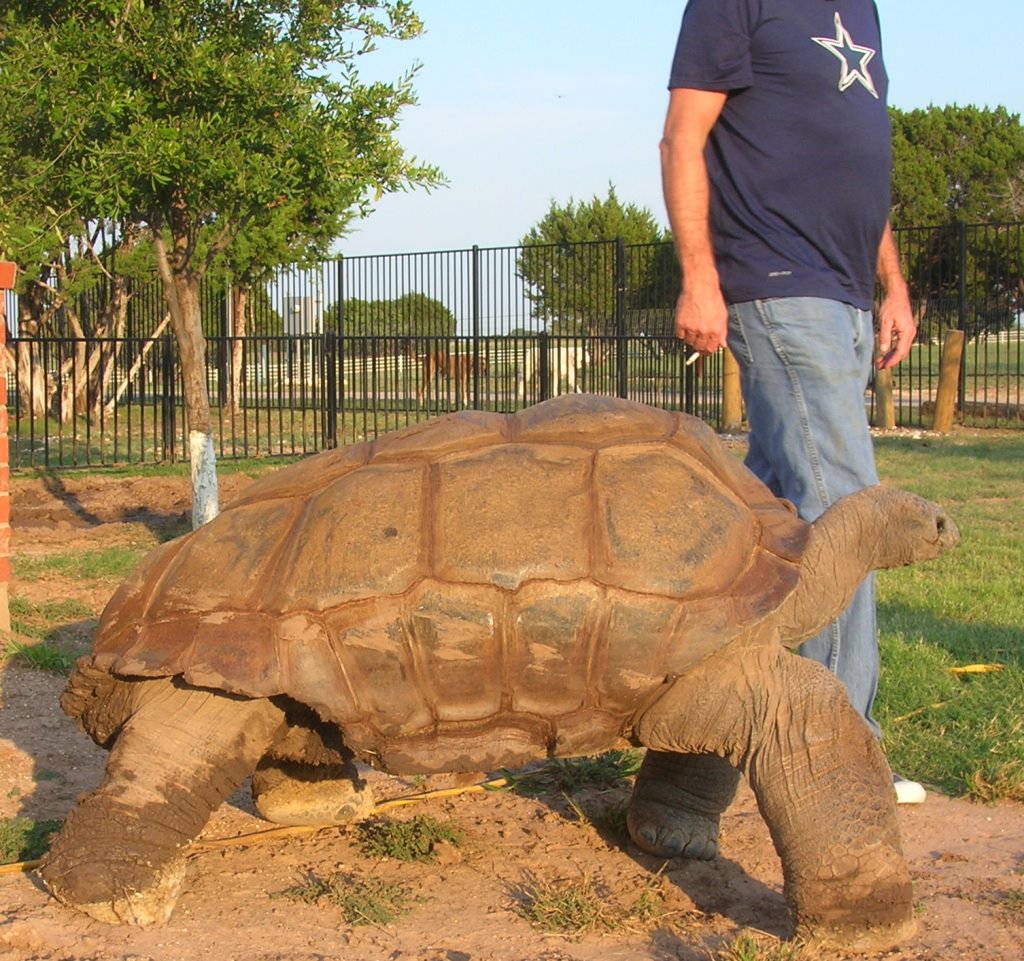
Ozzy is 170+ years old, and weighs between 550 and 600 pounds. He’s not aggressive at all, although I wouldn’t try to stand in his way. I don’t know that he’d bite, but he might push me over and step on me.

Here’s another pic that gives a better idea of how big this animal is. The guy in the picture is over 6 feet tall.

Charlie finds a fawn

Charlie found another fawn on our walk this morning. This is the neighbor’s fence, just across the street from our place.

Missing picture of Charlie and the fawn

(Yes, I really do need to scour my archives to find some of these missing pictures.)

Tuesday, he found one out by the compost pile in the back yard. I didn’t have him on the leash that time, although I was walking around the yard with him. When I looked around and saw his tail wagging, I went around the compost bin to see what he was up to. He was sniffing, licking, and prodding at a fawn that was lying there. I pulled Charlie away before he decided that it would be a tasty mid-morning snack.

Charlie’s good at finding these fawns in our yard. Years ago, he found one by the garage door.

It occurs to me that this is the first time I’ve uploaded a picture from my phone. I’ve taken a few shots in the past, but always forgot to upload them.

Zero turn radius lawn mower

My lawn tractor died a couple of weeks ago. Engine ran out of oil and seized up. No, I didn’t forget to add oil. A seal broke while I was mowing, oil leaked out, and … no more engine. The thing lasted almost 17 years, so I’m not terribly upset. I certainly got my money’s worth from that piece of equipment.

I considered buying a new engine for the old mower, but it just doesn’t make sense. For what it would cost to replace the engine and make a few other repairs that I’ve been putting off, I could buy a new mower with a larger engine and wider deck. The old mower is definitely being retired.

I’ve been looking at those zero-turn mowers for a few years, but there was no way I was going to buy one while I still had a perfectly good mower. But when the old mower died, I started looking again. The cost, though, is a big hurdle. The cost of a ZTR is approximately double that of a traditional lawn tractor with comparable features. For example, a lawn tractor comparable to mine is about $1,100 brand new. A ZTR with the same deck width will go for about $2300. Ouch.

Our neighbors offered to let me borrow the ZTR they bought a few years ago. Yesterday I walked over and got it.

Understand, our lot is about 1.75 acres. Most of that is grass, and there are many obstacles to mow around. With my old Craftsman mower, it would take me a minimum of three hours just to mow. Four hours if I skipped a week and the grass was long. That didn’t include trimming with the weed whacker or the little push mower. Doing a good job on our lawn is a five hour time commitment. At least, that’s what I thought.

It took me about five minutes to get accustomed to operating the ZTR. It took another ten minutes or so to realize that I didn’t want to use the ZTR the same way I used the old lawn tractor. The ZTR is so much more maneuverable that I can get into places I couldn’t with the old tractor. And I don’t have to do those silly 270 degree turns when mowing an irregular patch. With the ZTR, I can just … turn. In addition, it’s easy to adjust the speed of the ZTR: just push harder on the handles. With my old tractor, I had to change gears.

The combination of more maneuverability, adjustable speed, and a much stronger engine completely changed the way I mowed the lawn. Navigating around obstacles is almost a non-issue. I can trim closer to trees without continually shifting gears or making wide turn-arounds. The result is that there’s no need for trimming with the push mower. I’ll still need the weed whacker for a few places, but not near as much as before. Oh, and the increased cutting width (50″ as opposed to 42″) means fewer trips around the yard.

I mowed the entire lawn, which hadn’t been mowed in three weeks, in an hour and a half. The ZTR’s more powerful engine had no trouble with the longer grass. In all, I was able to do a better job in literally half the time it would have taken me with the lawn tractor. I’m sold.

There are a few drawbacks to the ZTR. First, you can’t get as many attachments. Many lawn and garden tractors have available attachments like grass catchers, tillers, and even front-end loaders. With the exception of a grass catcher on a few models, those attachments just aren’t available for the ZTRs. The ZTR is a mower, and it’s exceptionally good at that task. It is not a general-purpose lawn tractor.

Another drawback is pulling a trailer. The ZTR can easily pull my little trailer, but I’ll have to be careful not to turn too sharply. And backing up with a ZTR is rather difficult. It’s easy enough to back in a straight line, but turning while backing will require a lot of practice. Backing with an attached trailer would be a big mistake.

Finally, operating a ZTR requires a bit more concentration than operating a traditional lawn tractor. At least, I thought so. For sure, you can’t take one hand off the controls to scratch your nose like you would if you had a steering wheel. Removing one hand means that you start going in circles.

The ZTR is expensive, no doubt. But with it I can do a better job in less time. And considering how long I expect to keep the machine, the difference in price just isn’t a big issue. Not if my weekly five hour ordeal becomes a two hour job.

The things you see on the road

I had my bike repainted last year, and even started riding it. Then I got busy with other things (or maybe I just got lazy). The bike spent most of the last 12 months hanging in the garage overlooking the bandsaw. I’d take it out every couple of months just to assuage my own guilt, but then it’d go back on the rack and I wouldn’t think much about it for a while.

I’ve been saying for the last month that I’m going to get back on the bike, but I’ve been putting it off. This morning I got frustrated with the program I was working on, and decided to take a ride and clear my head. An hour on the bike usually does.

Every time I come back to cycling after a long absence, I unable to understand how I could possibly have stopped. That first few miles feels so good: back out on the road, enjoying the fresh air and the wind in my face, nothing heavy on my mind. It’s very liberating.

It hurts, of course. My legs aren’t used to climbing even the smallest hills. But I know that within a couple of weeks the pain will be gone and I’ll feel a lot better. I just can’t understand how I could have stopped riding again.

I took an experimental loop through a new subdivision and was on my way home when I saw a large group of riders–perhaps as many as 50–coming up on the other side of the road. There were two motorcycles in front, obviously part of the ride, and three vans following. One of the vans said, “Ride 2 Recovery” on it, and “Wounded Veterans Ahead.”

I had to go see what that was all about.

I turned around, sprinted past the vans, and caught up with the riders. I struck up a conversation with one of the riders, a former Army Ranger from Albuquerque, NM. They’re participating in the Texas Challenge: a 6-day ride from San Antonio to Arlington. The riders raise money to help support the programs that Ride 2 Recovery sponsors. I talked to this guy for a few more minutes, then rode up the line offering encouragement before turning around and heading home.

Had I been in better shape, I probably would have stayed with them all the way to Fort Hood, and then found a ride back somehow. But I figured that 50 miles was probably a bit too far for my first ride after over a year of not riding seriously.

“The Ride 2 Recovery,” the web site says, “is produced by the Fitness Challenge Foundation, (501C3) in partnership with the Military and VA Volunteer Service Office, to benefit Mental and Physical Rehabilitation Programs for our country’s wounded veterans that feature cycling as the core activity.”

Call it fate, coincidence, serendipity, whatever. The likelihood of me running into a group of riders on a Wednesday morning, out on the back roads on my first ride of the season is pretty low. But then, improbable events happen quite frequently. After all, people do win the lottery. Whatever the reason, or even if there was no reason, I sure am glad I encountered this group today. That’s some serious motivation.

A couple of yard pictures

I spent most of the weekend doing yard work. Specifically, burning the remains of the fig and the wisteria that didn’t fare well over two or three years of drought. I also took down the garden fence, seeing as how we hadn’t actually cultivated a garden for a few years.

Missing picture of a gate to nowhere

Removing the fence posts was no problem. But I set the gate posts in concrete. Removing those is going to be some work. Unless I decide to leave the gate as an artifact.

I also mowed the back yard. I ran out of time to do the front, and I won’t get to it until Sunday. That’s going to be a big job. The recent rains and abundant sunshine have made for ideal grass and weed growing conditions.

It’s surprising how much the grass grows in just a week. If I let it go two weeks, it will be high enough to scratch Charlie’s belly.

Charlie, by the way, is doing well. He was feeling his oats this afternoon, doing laps around the pool. Still a heck of a good lookin’ dog, ain’t he? The bald spots are from surgery to remove some mast cell tumors.

The death of Kim Jong-Il

The big news story today was the death of Kim Jong-il, leader of North Korea. Of all the commentary I heard, one idea struck me as rather funny in a “you’re more right than you realize” kind of way. I don’t recall who it was that NPR interviewed, but his comments were to the effect that the North Korean people either wouldn’t believe that the West was supplying food aid, or they would say that the aid was “tribute” demanded by the Dear Leader in lieu of him crushing us with his army.

Regardless of whether the commenter’s characterization of the North Korean people’s intelligence is correct (I somehow doubt they’re that stupid), the “tribute” comment is more correct than perhaps he meant it to be.

North Korea has a huge military–about 1.1 million armed personnel, and a reserve force of about 7.5 million. They have modern weapons, and from all reports have enough food, fuel, and ammunition to wage war for perhaps 100 days. I suspect that 100 days is an over-estimate, but even if it were just 50 days, they could do a lot of damage. It’s doubtful, though, that they could seize, occupy, and hold much territory for very long.

North Korea does, however, have nuclear weapons. Not that I think they’d use them. At least, Kim Jong-il was smart enough not to. He didn’t give a rip about his own people, but from all reports he was rather fond of his own skin. He sure didn’t want to end up like Adolf Hitler, Nicolae Ceaușescu, Saddam Hussein, Muammar Gaddafi, or any other national leader whose life ended with him being hunted down and executed by major powers or by his own people.

Kim Jong-il wouldn’t actually use his nuclear weapons (he was a lot of things, but never stupid), but he had no problems selling his nuclear technology, or using his nuclear capabilities as a bargaining chip. All he had to do was rattle his nuclear saber a bit and make vague noises about “talks.” The U.S., China, Russia, Japan, South Korea, and the U.N. would all bend over backwards to meet his demands for food aid or other concessions, just to get him to the bargaining table. And, like Lucy pulling the ball away after convincing Charlie Brown that “this time is different,” Dear Leader would invariably use some excuse–any excuse–to delay or halt talks after he got what he wanted. And, just like Charlie Brown, the world powers would fall for it every time.

Tribute? Perhaps not in the way that the term is typically used, but it amounted to the same thing. Kim Jong-il threw a tantrum and the world gave him whatever he wanted. You’ve seen the same kind of thing happen in the toy aisle of Wal-Mart a hundred times. The man was a tyrant and a master manipulator who seemed to get a real thrill out of making the rest of the world dance to his ridiculous tune.

We are well shut of Kim Jong-il. For reasons that escape me, the world kissed his ass to keep him quiet. I’ll never understand why we didn’t just ignore him. Why China kept propping him up is another mystery. I can understand South Korea treating him with kid gloves, because they didn’t want a war and because there are many South Koreans with family in the North. They don’t want another war where they’re shooting at their own kin.

Even though Kim Jong-il acted like a spoiled child, he was a known quantity. He was predictable within a fairly narrow range. We knew how to deal with him. We don’t know what form the new leadership will take in North Korea. Will Kim Jong-un take over? Will he become a figurehead who’s controlled by the old guard? That’s perhaps the scariest possibility: a young and inexperienced figurehead being controlled by the hard line old guard who have dreams of conquest. It would be enough to plunge the entire region into a war. Perhaps the entire world if China got involved on the side of the tyrants.

Let’s hope that cooler heads prevail.

WhittlePup takes five

Debra and I went to Zilker Botanical Garden on Sunday, and took Whittle Pup along. He got tired after wandering around for a while and asked to take a break with his frog buddies. The frogs didn’t show up, but Pup had a good time hanging out in the pond.

You are what you read

I’ve often heard, “You are what you eat” It’s true. What you eat and how much you eat accounts for a very large part of your physical development.

What you don’t hear as often (if ever) is that, mentally, you are what you read, watch, listen to, or otherwise experience.

Information theory deals with the quantification of information. A primary concern is entropy, which can be thought of as how much a random value differs from the expected value. In this context, the expected value is based on what is already known. The more the random value deviates from the expected value, the higher the entropy and thus the higher the information content.

Think of it this way. Imagine you’re standing outside in a rainstorm. Your friend approaches and says, “It’s raining.” The information content of that message is almost zero. The only thing you learned is that your friend is a master at stating the obvious, and you probably knew that already. Of course it’s raining!

Regardless of how many people approached to tell you that it’s raining, you wouldn’t learn anything new.

If your primary means of learning about what’s happening in the world is Fox News, Rush Limbaugh, and Glenn Beck, you’re not going to learn anything new. Oh, to the extent that you’re “keeping up with world events,” you’ll learn things. But that’s just trivia. The same thing will happen if your only source of news is The Huffington Post or  Michelle Malkin, or whatever narrowly-focused outlet you subscribe to.

If you depend on  just one or a very few sources for your news, the information content of the news that you consume will be incredibly low. Why? Because you’re going to hear exactly what you expect. If Congress passes a new jobs bill that the President signs, you already know what Rush Limbaugh is going to say about it. If the President signs a bill that reduces corporate income taxes, you already know what The Daily Kos is going to say about it.

If you hear exactly what you expect, then you’ve received no new information. You’re not learning anything.

The only learning that matters much is that which modifies your world view. Reading the same old opinions expressed on new topics only reinforces your current world view. If you want to learn something, you have to seek out information from sources that will present world views that differ from yours. Sure, some of them are bunk. Most of what Glenn Beck has to say is bunk, too, but that doesn’t stop millions of lazy people from agreeing with him because they can’t be bothered to seek out new sources of information and put forth the effort to evaluate it.

I’m not talking about changing fundamental beliefs. But all of us hold minor beliefs that are based on incorrect or outdated information. We believe things without understanding how we arrived at those beliefs, and then we hold onto those beliefs in spite of obviously correct conflicting evidence.

There’s nothing wrong with strong opinions. Without a strong opinion, it’s impossible to develop a strong argument for or against anything, and it’s impossible to devote your full energy to any pursuit. But those opinions must be weakly held, subject to examination and revision at any time based on new information. A truly wise person has strong opinions that are weakly held–the exact opposite of what partisans or tribalists of all stripes advocate.

There are incredibly intelligent people who are not particularly wise. They continually express just one point of view (typically in the political arena, but sometimes in others) blindly, pointing out the virtues of their side and the faults and foibles of the other side, but acknowledging neither the virtues of the other side nor the faults of their own side. At best, these people are unaware of their own ignorance. At worst, they’re intentionally trying to mislead or manipulate you. Either way, they are not credible sources of information.